Key Takeaways
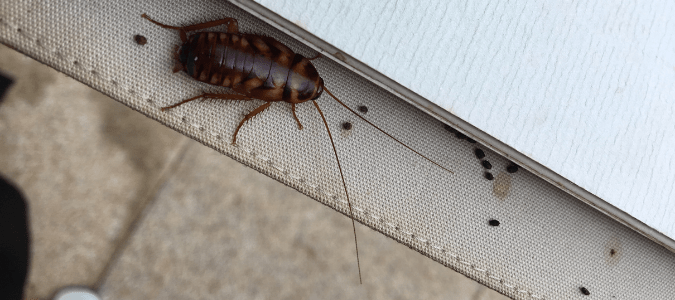
- Cockroach droppings look like small, dark brown or black pellets — often mistaken for coffee grounds, ground pepper, or specks of dirt.
- Smaller roaches like German cockroaches leave pepper-sized specks and smears. Larger roaches — American (palmetto bugs) and Oriental — leave cylindrical pellets with visible ridges down the sides.
- Finding droppings almost always means there’s an active roach problem hiding nearby. The droppings themselves release pheromones that pull in more roaches.
- Roach droppings are a known asthma and allergy trigger, especially for children. Always clean with a HEPA-filter vacuum and disinfectant — never dry-sweep.
- Cockroach poop can be confused with mouse droppings, bed bug stains, or black mold. Size, shape, ridges, and location are the giveaways.
- Multiple droppings, droppings in food prep areas, or any droppings paired with live roach sightings warrants a pro inspection.
In this guide:
- What cockroach droppings look like
- How droppings differ by species
- Where to look for them
- How to read the severity
- Telling them apart from mouse, bed bug, and mold marks
- Health risks
- How to clean them up safely
- Other signs of an infestation
- When to call a pro
Finding strange, dark brown pellets in a kitchen cabinet or along a bathroom baseboard is unsettling. You’re pretty sure what you’ve found is cockroach droppings — but you’re hoping you’re wrong. So what do cockroach droppings look like, and how serious is the problem if these really are roach droppings?
In general, roach droppings look like little black or dark brown pellets, very similar to coffee grounds or crushed pepper. When fresh, the pellets are usually round or oval. Unlike coffee grounds or actual pepper, they stick to surfaces and might smear when wiped. Older droppings start to flatten as roaches walk through their own waste. The bigger the problem, the more obvious the droppings. Cockroaches don’t care about cleanliness — they’re more than willing to leave waste where they live and eat. That means droppings show up most heavily where roaches spend the most time.
In dark, hard-to-reach spots where these pests gather, droppings stop looking like single pellets and start looking like a pervasive speckling. Really bad areas show up as a single solid stain. If that’s what you’re seeing in your home, it’s time to call an Orlando palmetto bug exterminator — but the next sections will help you spot the problem early, before it gets there.
How Cockroach Droppings Differ by Species
Not all roach droppings look alike. The species behind the mess changes the size, shape, and where you’ll find it.
German cockroaches are the most common indoor roach in Central Florida homes. Their droppings are tiny — under 2 mm — and look like flecks of black pepper or ground coffee. You won’t usually find isolated specks. They cluster densely around drawer tracks, cabinet hinges, and behind small appliances. Heavy dark staining on cabinet edges is often a sign of a German cockroach outbreak, not just spilled spice.
American cockroaches — the species most Floridians call palmetto bugs — leave bigger droppings. Think cylindrical pellets about a quarter-inch long with ridges running lengthwise down the sides. Color is dark brown to nearly black. These show up near drains, water lines, garages, and crawl spaces. Some palmetto bugs are also flying cockroaches in Florida, which can make finding droppings on high shelves a real possibility.
Oriental cockroaches prefer damp, dark areas — basements, utility sinks, and around leaky pipes. Their droppings are similar in size to American roach droppings but are black and slightly shinier.
Brown-banded cockroaches are smaller and less common. Their droppings are powdery, easy to overlook, and often mistaken for regular dust.
If you’ve been wondering whether you’re even looking at roach droppings at all — or whether the bug you saw was something else — here’s a guide to help you tell a cockroach apart from a beetle. And if the roach turned out to be in your pool or near drainage, you may actually be dealing with a water bug vs. cockroach ID question.
Where to Look for Cockroach Droppings
Roaches are good at hiding. Their droppings, less so — once you know where to look.
Start in the kitchen. Open the cabinet under the sink and check the back corners and along the plumbing. Look behind the fridge, behind the stove, inside the cabinet above the fridge. Pull out drawers and inspect the tracks and the back edges. Pantries and food storage areas are next — pay extra attention to the corners and seams where shelving meets walls.
Bathrooms are second. Check under sinks, around the toilet base, behind the water heater, and inside the linen closet. Roaches need moisture, and any plumbing fixture is a draw.
Don’t skip the less-obvious spots. Inside loose wallpaper, along baseboards, in wall cracks, behind picture frames, inside cardboard boxes you’ve had sitting in the garage, and along the underside of any furniture that doesn’t get moved. Florida garages, utility rooms, and screened patios often turn up droppings because they’re warm, humid, and quiet.
How Bad Is the Problem? Reading the Severity
A few scattered droppings in one spot might mean a single roach passed through. A peppered surface in multiple locations means a settled population.
Here’s the rough scale most pros use:
- A few specks in one area — possible recent entry, worth a look but not yet an outbreak.
- Multiple clusters in different rooms — active outbreak. Treat it seriously.
- Solid dark staining or visible smears — heavy outbreak. DIY rarely catches up at this level.
One thing that surprises homeowners: even an immaculate house can end up with a roach problem. Roaches often arrive as hitchhikers — hidden inside grocery bags, cardboard, secondhand furniture, even kids’ backpacks. Curious how that happens? It’s worth reading up on how cockroaches hitchhike into homes before assuming a cleanliness issue is to blame.
Cockroach Droppings vs. Mouse, Bed Bug, and Mold Marks
Several other pest signs get confused with roach droppings. Here’s how to tell them apart.
Mouse droppings are bigger — usually 5 to 10 mm long, smooth, and pointed at one or both ends, more like a dark grain of rice. They lack the ridges you’ll see on larger roach droppings. Mouse droppings also tend to leave linear trails along walls; roach droppings cluster densely near hiding spots and food.
Bed bug stains look more like dark reddish-brown smears or small dots on bedsheets, mattress seams, or pillowcases. Bed bugs stay where people sleep — which is the opposite of cockroaches, who prefer dark, out-of-the-way places.
Black mold can look similar to old, smeared cockroach droppings — same dark, dotted look in damp corners. The tell is the smell. Black mold smells musty and earthy. Cockroach droppings smell pungent and actively unpleasant, with an oily sour note that’s hard to forget once you’ve encountered it.
Are Cockroach Droppings Dangerous?
Yes — more than people realize.
The proteins inside dried cockroach droppings, shed skins, and body parts are known asthma and allergy triggers. According to the American Lung Association, cockroach allergens can trigger asthma attacks and allergic reactions, especially in children and people with breathing issues. These allergens go airborne when droppings dry out and get stirred up. That’s why dry-sweeping makes things worse.
Roaches also carry bacteria. Cockroaches forage through garbage, drains, and decaying matter before walking across kitchen counters, contaminating any surface they touch with pathogens like Salmonella and E. coli. The University of Florida IFAS Extension notes that the American cockroach has been linked to mechanically spreading multiple disease-causing organisms.
And here’s the kicker: roach droppings actually pull in more roaches. The droppings release aggregation pheromones — chemical signals made by gut bacteria — that tell other roaches this is a safe place to gather. That’s why outbreaks cluster so tightly in specific spots. And it’s why prompt cleanup matters even after pro treatment.
How to Clean Up Cockroach Droppings Safely
A vacuum and a bottle of disinfectant — but in the right order, with the right protection.
- Wear gloves and a mask. The allergen proteins go airborne when stirred up. A simple dust mask isn’t overkill.
- Vacuum with a HEPA filter. This traps the fine particles a regular vacuum just blows around. Never dry-sweep with a broom or paper towel.
- Disinfect the surface. Hot soapy water first, then a household disinfectant. Pay extra attention to food prep areas.
- Bag and dispose. Seal the vacuum contents or wipes in a bag and take it outside right away. Don’t leave roach material sitting in an indoor trash can.
A note: cleaning droppings doesn’t kill the source. It cuts down the pheromone trail and the allergen load, but the colony is still hiding somewhere. Cleanup is one piece of the fix, not the whole fix.
Other Signs of a Cockroach Infestation
If you’ve found droppings, look for these nearby. They confirm what you already suspect.
Egg casings. Roach egg cases — called oothecae — look like small, hard, brown or black capsules with a smooth or banded surface. Depending on the species, each case can hold anywhere from about 16 to 50 baby roaches. If you spot an egg case, you have an active reproducing population.
Shed skins. Roach nymphs molt several times before reaching adulthood — generally six to eight times across their lifespan. Each molt leaves behind a hollow exoskeleton, which means there may be more roach skins in your home than actual roaches. Finding empty skins in cabinet corners or behind appliances means babies are growing into adults right now.
A pungent, oily smell. Heavy outbreaks carry a distinctive smell. It’s sour, musty, and unpleasant. Once you’ve smelled it, it’s recognizable instantly.
Live cockroaches. If you see a cockroach, you likely have others hidden out of sight. You might try to rationalize that it’s some kind of lone wolf, but there’s almost never just one cockroach in a home. Daytime sightings — especially of small German roaches scurrying when a light comes on — almost always mean there’s a population large enough that their hiding spaces are overcrowded.
For a deeper checklist of what to look for, here’s the full breakdown of other common signs of a roach infestation.
When to Call a Professional
Finding cockroach droppings is the signal. Treating the roach problem underneath is the work. Roaches leave droppings in discreet places, so if you’re finding them at all, you likely need help from a pro to get rid of the pests behind them.
Store-bought sprays often only kill adults. They leave egg cases untouched. That means the cycle restarts in a few weeks, and the population bounces back. A licensed pest pro can identify the species, locate harborage points, and treat the full life cycle so the colony breaks down rather than rebounds. If you want a sense of what’s involved before calling, here’s an overview of how to get rid of a roach infestation the right way.
For homeowners in Central Florida, ABC Home & Commercial Services has been treating roach problems since the company expanded into Orlando in 2006. The team is QualityPro certified and trains just for the species most common in this climate — German roaches, American roaches, and the palmetto bugs Floridians know all too well.
If droppings are showing up in more than one location, or anywhere near where food gets prepared, schedule an inspection with an Orlando palmetto bug exterminator at ABC. One call handles it.
Frequently Asked Questions
Can cockroach droppings make you sick?
Yes. Roach droppings carry bacteria like Salmonella and E. coli that can contaminate food prep surfaces and cause gut illness. The bigger health concern for most homeowners is respiratory: dried roach droppings release allergen proteins that trigger asthma and allergy attacks, especially in kids. So while a one-off speck isn’t a crisis, repeated exposure in a kitchen or bedroom can absolutely make sensitive people sick over time.
How do I tell roach droppings from mouse droppings?
Size and shape. Roach droppings are smaller (under 2 mm for German roaches, up to about 1/4 inch for American), have blunt ends, and often show visible ridges running lengthwise. Mouse droppings are bigger (5 to 10 mm), smooth, and pointed at one or both ends — closer to a dark grain of rice. Mouse droppings also leave linear trails along walls, while roach droppings cluster densely near hiding spots.
What does dried cockroach poop look like?
Fresh droppings are dark brown or black and slightly glossy. As they age and dry, they fade to a lighter brown or grayish-brown and become powdery instead of smeary. Older droppings can crumble when touched. This matters: fresh dark droppings mean an active roach problem right now. Lighter, dried-out droppings could mean an older problem that may or may not still be active.
Do baby roaches leave droppings?
Yes. Roach nymphs produce the same kind of droppings as adults, just smaller. Baby roach droppings often look like fine dark dust or pepper specks that homeowners mistake for dirt. Finding very tiny droppings alongside larger ones in the same area is a strong sign of a breeding colony, not just a few wandering adults.
Why am I finding cockroach droppings but no roaches?
Roaches are nocturnal and excellent at hiding. You can have a real outbreak without ever spotting a roach during the day. Droppings show up in their travel and hiding zones — wall cracks, cabinet backs, under appliances — long before homeowners catch them in the open. Finding droppings means they’re there. Finding them in multiple rooms usually means the population is settled in.
Do cockroach droppings attract more roaches?
Yes. Roach droppings release aggregation pheromones — chemical signals made by gut bacteria — that tell other roaches this is a safe place to gather. That’s why outbreaks cluster so densely in specific spots, and why prompt cleanup matters even after treatment.
How do I clean cockroach droppings safely?
Wear gloves and a mask. Vacuum droppings with a HEPA-filter vacuum so allergen particles don’t go airborne. Never dry-sweep — it stirs up the proteins that trigger asthma. After vacuuming, wipe the surface with hot soapy water followed by a household disinfectant. Bag the vacuum contents and dispose of them outside.
How long do cockroach droppings stay around?
Indefinitely, if no one cleans them up. Droppings don’t decay quickly — they dry out and break down into airborne allergen particles that can stay in carpets, dust, and HVAC systems for months or even years after the roaches are gone. That’s why treating a roach problem always has to include thorough cleanup of the droppings themselves, not just killing the bugs.
ABC Can Eliminate the Roaches on Your Property
Cockroaches are prolific breeders who can find their way into nearly any home. When it comes to controlling a cockroach infestation, you need a pest control specialist who can create a thorough, effective treatment plan to ensure that your roach population doesn’t continue to multiply. At ABC Home & Commercial Services, we create customized pest management plans so you don’t have to worry about any more run-ins with roaches.
{
“@context”: “https://schema.org”,
“@type”: “FAQPage”,
“mainEntity”: [
{
“@type”: “Question”,
“name”: “Can cockroach droppings make you sick?”,
“acceptedAnswer”: {
“@type”: “Answer”,
“text”: “Yes. Roach droppings can carry bacteria like Salmonella and E. coli that may contaminate food prep surfaces and cause gut illness. Dried roach droppings can also release allergen proteins that trigger asthma and allergy symptoms, especially in children and sensitive individuals.”
}
},
{
“@type”: “Question”,
“name”: “How do I tell roach droppings from mouse droppings?”,
“acceptedAnswer”: {
“@type”: “Answer”,
“text”: “Roach droppings are usually smaller, have blunt ends, and may show visible ridges lengthwise, especially from larger roaches. Mouse droppings are bigger, smooth, and pointed at one or both ends, resembling dark grains of rice. Mouse droppings often appear in trails along walls, while roach droppings cluster near hiding spots.”
}
},
{
“@type”: “Question”,
“name”: “What does dried cockroach poop look like?”,
“acceptedAnswer”: {
“@type”: “Answer”,
“text”: “Dried cockroach poop is usually dark brown, black, or faded grayish-brown. It may look powdery, crumbly, or like old coffee grounds or pepper specks. Fresh droppings are darker and may smear, while older droppings tend to dry out and crumble.”
}
},
{
“@type”: “Question”,
“name”: “Do baby roaches leave droppings?”,
“acceptedAnswer”: {
“@type”: “Answer”,
“text”: “Yes. Baby roaches, also called nymphs, leave droppings just like adult roaches, but their droppings are smaller. They often look like fine dark dust or pepper specks. Finding tiny droppings alongside larger ones can indicate a breeding colony.”
}
},
{
“@type”: “Question”,
“name”: “Why am I finding cockroach droppings but no roaches?”,
“acceptedAnswer”: {
“@type”: “Answer”,
“text”: “Roaches are nocturnal and very good at hiding, so it is common to find droppings before seeing live roaches. Droppings often appear in travel paths and hiding areas such as wall cracks, cabinet backs, and under appliances. Droppings in multiple rooms can indicate an established infestation.”
}
},
{
“@type”: “Question”,
“name”: “Do cockroach droppings attract more roaches?”,
“acceptedAnswer”: {
“@type”: “Answer”,
“text”: “Yes. Cockroach droppings can release aggregation pheromones that signal to other roaches that an area is a safe place to gather. This is one reason infestations often cluster in specific areas and why cleanup is important after treatment.”
}
},
{
“@type”: “Question”,
“name”: “How do I clean cockroach droppings safely?”,
“acceptedAnswer”: {
“@type”: “Answer”,
“text”: “Wear gloves and a mask. Vacuum droppings with a HEPA-filter vacuum and avoid dry sweeping, which can stir allergens into the air. After vacuuming, clean the area with hot soapy water and then use a household disinfectant. Seal and dispose of vacuum contents or wipes outside.”
}
},
{
“@type”: “Question”,
“name”: “How long do cockroach droppings stay around?”,
“acceptedAnswer”: {
“@type”: “Answer”,
“text”: “Cockroach droppings can remain indefinitely if they are not cleaned up. They dry out and can break down into allergen particles that remain in dust, carpets, and HVAC systems for months or longer. Thorough cleanup is important even after the roaches are treated.”
}
}
]
}