Key Takeaways
- Cyanuric acid (CYA) acts like sunscreen for pool chlorine — without it, UV destroys half of unprotected chlorine in just 17 minutes.
- The Pool & Hot Tub Alliance ANSI standard sets the ideal CYA range at 30–50 ppm for traditional chlorine pools and 60–80 ppm for salt water pools.
- Cyanuric acid is not the same as muriatic acid. Muriatic acid lowers pH; CYA protects chlorine from sunlight.
- Low CYA means chlorine burns off fast, leading to algae and cloudy water. High CYA causes chlorine lock, where chlorine reads fine on tests but can’t effectively sanitize.
- The only reliable way to lower CYA is to drain and dilute — it does not evaporate or break down.
- Most pools drift into high CYA because Trichlor chlorine tablets are 50–55% cyanuric acid by weight.
Introduction
Clear pool water doesn’t always mean safe pool water. Many Houston pool service customers test chlorine, pH, and alkalinity faithfully every week — and skip the one chemical reading that quietly controls whether any of those other numbers actually matter. That reading is cyanuric acid.
When was the last time you tested for it?
Cyanuric acid (CYA) protects the chlorine in your pool from being destroyed by the sun. Too little and chlorine vanishes within hours. Too much and chlorine becomes nearly useless, even when test strips say everything’s fine. Either way, the result is the same: algae, cloudy water, and a pool that fights back against every chemical you throw at it.
ABC Home & Commercial Services has been handling pool chemistry calls across the Houston metro for over 40 years. With 3,575+ five-star reviews, a BBB A+ rating, and a third-generation family-owned operation backing every service call, the team knows exactly what high CYA looks like by July — and what it costs when it gets ignored.
This guide breaks down what CYA does, what the ideal range looks like, how to fix it when it’s off, and why most pools drift into high-CYA territory without the owner ever noticing.
What Is Cyanuric Acid?
Cyanuric acid is a chlorine stabilizer. Some pool supply stores label it pool conditioner or just stabilizer. It does one job, and it does it well: it bonds loosely with free chlorine and shields it from the sun’s ultraviolet rays.
Without CYA, chlorine in an outdoor pool is in serious trouble. Pool chemistry research consistently shows that UV destroys half of unprotected pool chlorine in just 17 minutes of direct sunlight. By the end of a sunny Houston afternoon, the chlorine you poured in at noon is mostly gone. Add cyanuric acid, and chlorine lasts three to five times longer — sometimes more, depending on UV exposure.
Don’t Confuse Cyanuric Acid With Muriatic Acid
This one trips up new pool owners constantly, and it shows up in service calls all summer.
Muriatic acid lowers pH and total alkalinity. It’s harsh, fast-acting, and used in small doses to bring a high-pH pool back into balance.
Cyanuric acid stabilizes chlorine. It’s slow-dissolving, builds up over time, and has nothing to do with pH.
“Both products have ‘acid’ in the name and that’s where the similarity ends. Add muriatic when chlorine is right and pH is too high. Add cyanuric when chlorine is burning off too fast in the sun.”
— Brent Weikel, Pool Manager, ABC Home & Commercial Services Houston
Mix them up — or add either one without knowing your current readings — and you’ll swing your water chemistry hard in the wrong direction.
Where Cyanuric Acid Comes From in Your Pool
CYA enters your pool through one of three routes:
- Pure stabilizer or conditioner — granular or liquid, added intentionally when CYA levels are low.
- Trichlor chlorine tablets — the most common route by far. Trichlor (trichloroisocyanuric acid) tablets are 50 to 55% cyanuric acid by weight, and one pound of Trichlor in 10,000 gallons of water increases CYA by approximately 6–6.5 ppm. Every tablet you drop in the floater adds CYA along with chlorine.
- Dichlor shock — another stabilized chlorine product that carries CYA into the water.
Calcium hypochlorite (cal-hypo), lithium hypochlorite, and liquid bleach are unstabilized chlorine sources. They don’t contain CYA. Some pool service pros switch pool owners to unstabilized chlorine specifically to stop CYA from creeping higher.
What’s the Acceptable Range for Cyanuric Acid in a Pool?
For a traditional outdoor chlorine pool, the target range is 30–50 ppm.
That number isn’t a guess. The Pool & Hot Tub Alliance ANSI/APSP/ICC-11 standard for residential pool water quality sets the ideal range at 30–50 ppm with a maximum of 100 ppm. That’s the official industry benchmark recognized across the U.S.
Why those specific numbers? Below 30 ppm, you’re burning through chlorine unnecessarily. Above 100 ppm, chlorine effectiveness drops sharply — and most homeowner test strips can’t even read CYA accurately past 100, which means by the time the strip flags it, levels are usually much higher.
Quick reference:
- Below 30 ppm — chlorine burns off too fast under UV. Expect to chase chlorine readings and see algae move in.
- 30–50 ppm — the sweet spot for most chlorine pools.
- 50–100 ppm — diminishing returns. Chlorine still works but loses efficiency as levels climb.
- Above 100 ppm — chlorine lock territory. Time to act.
Salt water pools play by a slightly different rulebook — more on that below.
How Often Should You Test Cyanuric Acid?
Test CYA at least once a month during the swim season, and any time you’ve added a significant amount of fresh water (rain, refill, splash-out). If you use chlorine tablets as your primary sanitizer, bump that to once every two weeks so you catch the slow climb before it becomes a problem.
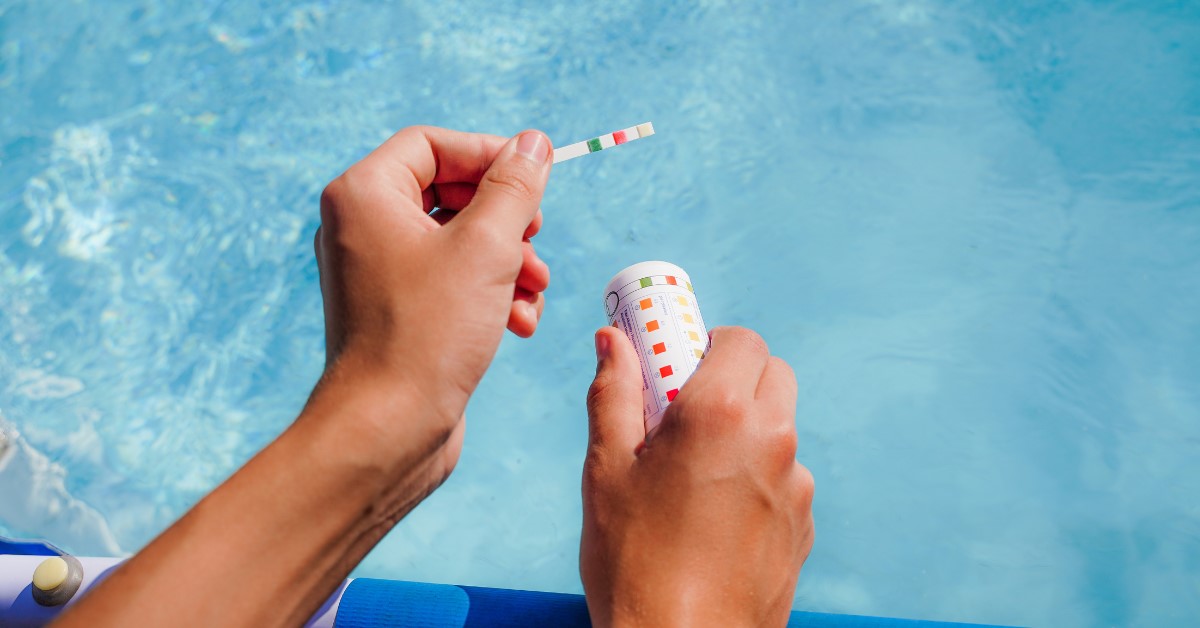
Most multi-parameter test strips include a CYA panel. For more accurate readings — especially above 80 ppm where strips get unreliable — a liquid turbidity test (the kind that uses a clear vial and a black dot at the bottom) is the standard.
Low Cyanuric Acid: Under 30 ppm
When CYA drops below 30 ppm, the signs show up fast.
The clearest symptom is chlorine that disappears overnight. You add chlorine in the evening, test in the morning, and the reading is back near zero. That’s not bacteria consuming the chlorine — it’s UV burning unstabilized chlorine off the water within hours.
A pool stuck in this cycle will turn cloudy, then green, no matter how much chlorine you keep pouring in. The chlorine simply isn’t sticking around long enough to sanitize anything. This is one of the most common reasons a pool turns green overnight — homeowners assume they have an algae problem when the real issue is a CYA reading they never tested.
How to Add Cyanuric Acid to Your Pool
If your CYA is low, here’s the right way to bring it up:
- Test first. Confirm the current reading with a fresh test. Most owners aim for 40 ppm, comfortably in the middle of the range.
- Calculate the dose. Stabilizer product labels include dosage charts. A common reference point: about 13 ounces of pure cyanuric acid raises CYA by roughly 10 ppm in a 10,000-gallon pool.
- Pre-dissolve the granular stabilizer. Cyanuric acid is acidic and slow to dissolve. Dissolve the dose in a bucket of warm pool water first, then pour the slurry slowly around the perimeter with the pump running. Never sprinkle granules directly onto a vinyl liner or fresh plaster.
- Run the pump. Keep circulation running for at least a few hours after the addition.
- Wait 48 hours, then retest. Stabilizer takes time to fully integrate into the water.
Don’t backwash for 3–5 days after adding CYA. Backwashing flushes stabilizer out of the filter before it has time to fully dissolve. That’s expensive product down the drain.
High Cyanuric Acid: Over 100 ppm
This is the more common Houston problem, and it catches owners completely off guard.
Here’s the picture: chlorine reads fine on the test strip. pH is balanced. Alkalinity is in range. The water still turns cloudy. Algae keeps coming back. You shock the pool, and a week later it’s right back where it started.
That’s chlorine lock.
What “Chlorine Lock” Actually Means
The term is a little misleading, and it’s worth understanding why.
Chlorine in pool water exists in two forms: a bound reservoir form (chlorinated cyanurates) and an active sanitizing form (hypochlorous acid, or HOCl). The active form is the one that actually kills bacteria, viruses, and algae. When CYA climbs too high, more chlorine sits in the bound reservoir and less is available as HOCl — meaning the same free chlorine reading translates to far less actual disinfection power. Standard test kits read total free chlorine, which is why the reading looks fine even as effective sanitizing drops off a cliff.
“Homeowners see a normal chlorine reading and assume the pool is sanitized. With cyanuric acid above 100, that reading is misleading. The chlorine is there. It just can’t do its job.”
— Brent Weikel, Pool Manager, ABC Home & Commercial Services Houston
The CDC’s Model Aquatic Health Code addresses this for public pools specifically. The CDC’s 2016 MAHC recommends that hyperchlorination response to fecal incidents requires CYA levels not exceed 15 ppm — a far lower threshold than residential standards, set because high CYA dramatically extends the time needed to inactivate chlorine-resistant pathogens like Cryptosporidium. That 15 ppm rule applies to commercial pools, not residential — but the underlying science is the same. The higher your CYA, the slower your chlorine.
For a residential pool, high CYA translates to slow algae growth, persistent cloudiness, and a sanitation problem most owners never see coming.
How to Lower Cyanuric Acid in Your Pool
Here’s the rule nobody likes hearing: cyanuric acid does not evaporate. It doesn’t break down in sunlight. Pool chemicals don’t neutralize it. The only reliable way to lower CYA is to dilute the water.
There are CYA-reducer products on the market. Pool chemistry professionals who have tested these products extensively report inconsistent results, and most do not recommend them as a primary solution. Reverse osmosis filtration works but is expensive and not widely available for residential pools in Houston. Partial or full drainage remains the practical solution for nearly every homeowner.
Decision Tree: How Much to Drain
- 60–100 ppm: A partial drain and refill usually brings levels back in range. If CYA is at 80 ppm and you want 40 ppm, you’ll need to replace roughly 50% of the water.
- Over 100 ppm: A full drain is typically required, especially because CYA bonds with pool plaster and continues to leach back into refill water if the walls aren’t rinsed during the drain.
Drain-Down Procedure
The procedure looks simple on paper. The mistakes are expensive.
- Turn off all pool equipment. Pumps, heaters, salt cell, automation — everything off before the water drops. Equipment running with no water flow will burn out within minutes.
- Check the ground conditions before you start. Never drain a pool when the soil is saturated. Groundwater hydrostatic pressure can lift an empty pool out of the ground — a catastrophic failure that can require complete pool replacement and tens of thousands of dollars in repairs. After heavy Houston rain, wait several days for the soil to dry.
- Open the hydrostatic relief valves. Most inground pools have hydrostatic pressure relief plugs in the deep end. These should be opened during a drain to let groundwater pressure equalize, preventing the pool from floating.
- Drain and rinse the walls as you go. This is the step pool owners skip most often — and it’s the most important. CYA bonds to pool plaster. Drain without rinsing, and the new water pulls CYA right back out of the walls.
- Stop the drain at the right point. For partial drains, stop at the calculated level. For full drains, stop just below the main drain to keep the surface clean.
- Refill to the middle of the tile line — without stopping. A paused fill leaves a permanent line (some pool pros call it a toilet bowl ring) where the fill water sat against the dry plaster. Once that ring sets in, it doesn’t come off with normal cleaning.
- Restore power and prime the pumps. Pumps that ran dry need to be primed before restart. If yours doesn’t catch — making a humming sound without actually moving water — that’s often a capacitor or impeller issue that needs professional diagnosis before any more electrical attempts.
- Rebalance the water. Test pH, alkalinity, calcium hardness, CYA, and chlorine. Bring everything back into range before swimmers go back in.
“A drain-down isn’t just about getting the water out. It’s about timing it for the ground conditions, opening the relief valves, rinsing the plaster, and filling without stopping. We see DIY drains every season that leave a permanent ring around the pool, damage equipment, or worst case, lift the pool out of the ground entirely.”
— Brent Weikel, Pool Manager, ABC Home & Commercial Services Houston
ABC’s Houston pool team handles drain-downs as a routine service. The judgment calls — ground saturation, partial vs. full drain, plaster condition, hydrostatic relief — are where 40+ years of Houston experience earns its keep. Call (281) 730-9500 to schedule a pool chemistry assessment.
Cyanuric Acid in Salt Water Pools: Why the Range Is Different
Salt water pools play by their own rules, and salt pool owners reading this need a different target than chlorine pool owners.
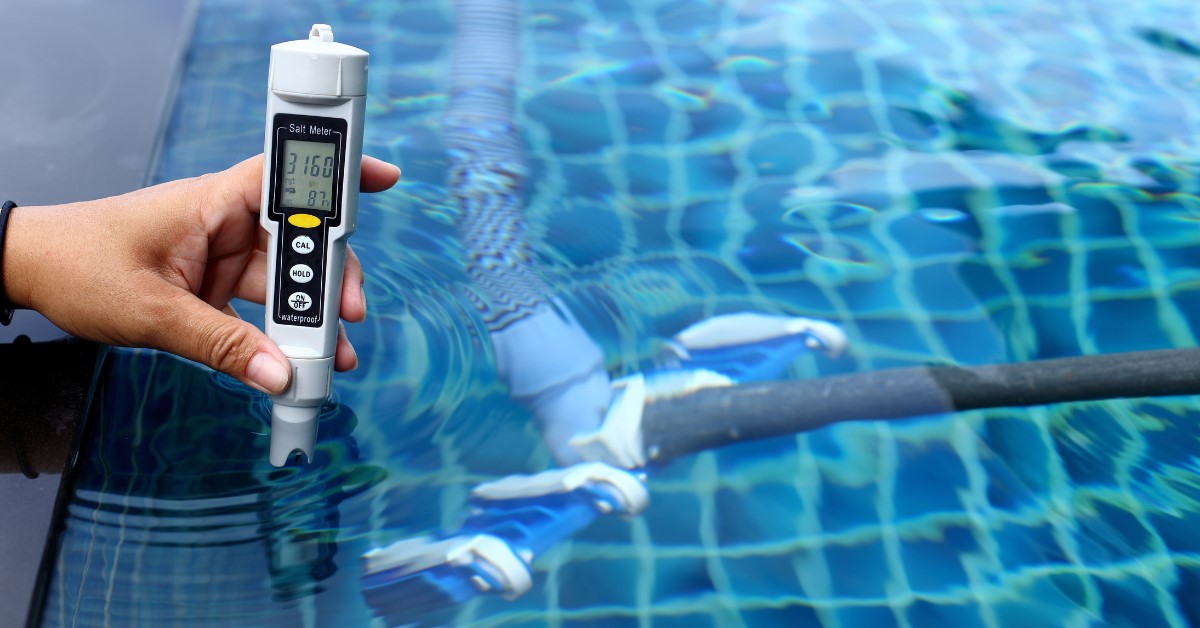
The ideal CYA range for a salt water pool is 60–80 ppm — higher than the 30–50 ppm range for traditional chlorine pools.
The reason is mechanical. Salt water pools don’t use stabilized chlorine. A salt chlorine generator produces chlorine from dissolved salt through electrolysis, and the chlorine it produces is unstabilized — meaning no built-in UV protection. The chlorine produced by a salt cell is highly vulnerable to UV degradation, and studies show up to 90% of unstabilized chlorine can be lost to direct sunlight within two hours.
To compensate, salt pool manufacturers recommend keeping CYA higher — 60 to 80 ppm — to slow that UV burn-off and let the salt cell keep up with demand without running constantly.
A few things salt pool owners should know:
- You still need to add stabilizer manually. Salt cells don’t produce CYA. It has to be added as a separate stabilizer product.
- Higher CYA means higher target chlorine. At 70 ppm CYA, target free chlorine around 5 ppm — higher than a chlorine pool because the CYA is also higher.
- Above 100 ppm is still too high for salt pools. The higher base range doesn’t mean unlimited headroom. Chlorine lock affects salt pools the same way it affects chlorine pools.
If your salt pool is fighting algae and the salt cell is running at 80% or higher output, low CYA is a common (and overlooked) culprit.
Why Cyanuric Acid Climbs Over Time
For a chemical that never evaporates, CYA has a way of sneaking up on pool owners. Here’s why.
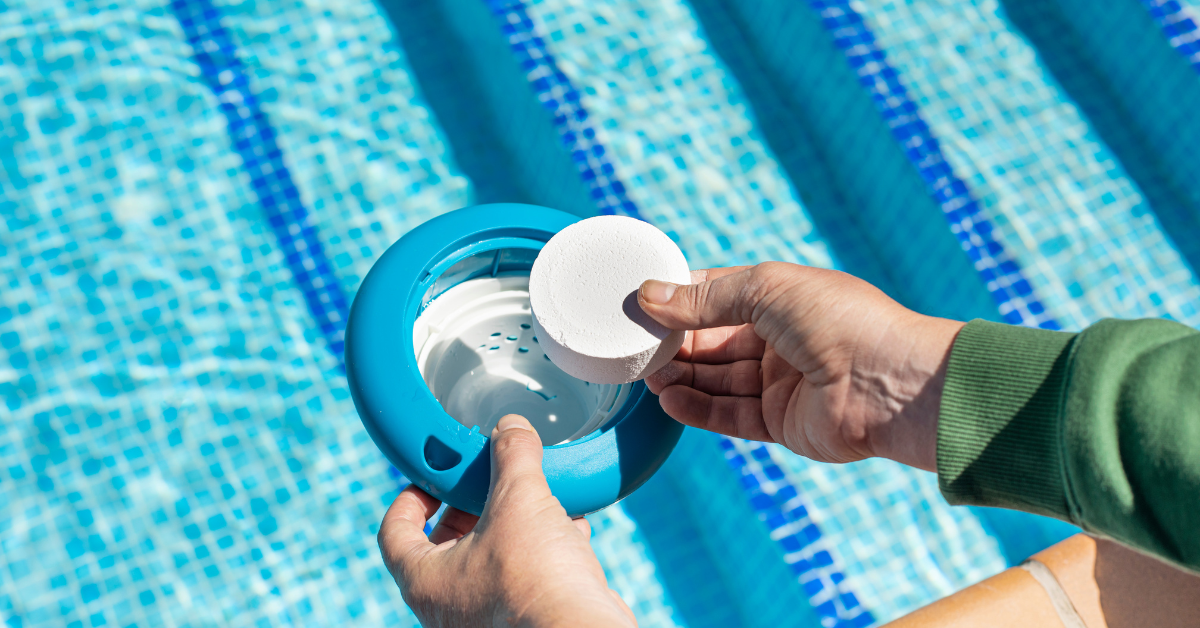
The single biggest source of rising CYA is Trichlor chlorine tablets. Trichlor is 50–55% cyanuric acid by weight. One pound of Trichlor in 10,000 gallons of water raises CYA by roughly 6–6.5 ppm.
Run the math on a Houston swim season:
- Typical residential pool: 15,000 to 20,000 gallons
- Typical Trichlor consumption: 1 to 2 tablets per week through the season
- Each 3-inch Trichlor tablet weighs about 8 ounces
- CYA increase per tablet in a 15,000-gallon pool: roughly 2–3 ppm
Over a 20-week Houston swim season, that’s anywhere from 40 to 120 ppm of CYA added — on top of whatever level you started with. Pools that open the season at a healthy 40 ppm can easily hit 120+ ppm by August.
Things that reduce CYA happen far more slowly:
- Splash-out and evaporation refill — small amounts of CYA leave the pool each season, but new fill water doesn’t reduce CYA proportionally.
- Heavy rain — a major Houston downpour can dilute CYA somewhat, but rarely enough to offset Trichlor accumulation.
- Backwashing sand or DE filters — pulls some CYA out, but again, slowly.
The accumulation always outpaces the loss. That’s why pools that rely on Trichlor exclusively almost always end up in high-CYA territory eventually. Some pool owners rotate to unstabilized chlorine (cal-hypo) mid-season specifically to slow the climb.
“Most homeowners don’t realize the chlorine tablets they trust are quietly driving CYA up all summer. By August we’re seeing pools at 150, 200 ppm — and the homeowner has been adding more shock the whole time, wondering why nothing works.”
— Brent Weikel, Pool Manager, ABC Home & Commercial Services Houston
When to Call a Houston Pool Professional
Some pool chemistry tasks are fine to handle yourself. Cyanuric acid management — especially a full drain-down — usually isn’t one of them.
The judgment calls that matter:
- Reading ground conditions before draining. Saturated soil after a Houston storm can lift a pool right out of the ground. Knowing when it’s safe to drain takes local experience.
- Opening hydrostatic relief valves correctly during the drain.
- Rinsing plaster as the water drops. Skip this step and the new water inherits half the old CYA problem.
- Filling without stopping to avoid the permanent ring stain.
- Priming pumps and restoring chemistry correctly after a refill.
ABC’s Houston pool team handles drain-downs, CYA rebalancing, equipment service, and ongoing pool maintenance for homeowners across the Houston metro. The team includes seasoned pool professionals who handle this exact scenario every week through the summer.
Call ABC at (281) 730-9500 to schedule service.
Frequently Asked Questions
What is cyanuric acid in a pool?
Cyanuric acid (CYA), also called pool stabilizer or pool conditioner, is a chemical that protects chlorine from being destroyed by the sun’s UV rays. It bonds loosely with free chlorine, slowing UV breakdown and letting chlorine sanitize the water for hours longer than it would unprotected.
Is cyanuric acid the same as muriatic acid?
No. Muriatic acid is a strong acid used to lower pool pH and total alkalinity. Cyanuric acid is a chlorine stabilizer that protects chlorine from UV degradation. They serve completely different purposes and should never be substituted for each other.
What happens if cyanuric acid is too high in a pool?
Above 100 ppm, chlorine becomes far less effective at sanitizing — a condition often called chlorine lock. The chlorine reading on test strips can still look normal, but the water becomes susceptible to algae, cloudiness, and bacterial growth. The only reliable fix is dilution through a partial or full drain.
Can you swim in a pool with high cyanuric acid?
Technically yes, swimming in a pool with elevated CYA is not directly dangerous at moderate levels. The bigger concern is that high CYA reduces chlorine’s sanitizing power, so the water may not be effectively disinfected against bacteria and algae. That makes the water less safe — not because of the CYA itself, but because of what isn’t being killed. Same logic applies when you spot tiny bugs swimming in pool water — clear water and a normal chlorine reading don’t tell the whole sanitation story.
What is chlorine lock?
Chlorine lock describes what happens when cyanuric acid levels get high enough that chlorine can’t effectively sanitize. Technically, the chlorine isn’t locked — it just shifts heavily into a bound reservoir form and away from the active killing form (hypochlorous acid). Tests still read free chlorine, but actual sanitizing power drops sharply.
How do you lower cyanuric acid in a pool?
The only reliable way is to dilute the water by partially or fully draining and refilling. CYA doesn’t evaporate, doesn’t break down in sunlight, and isn’t neutralized by other pool chemicals. For levels between 60 and 100 ppm, a partial drain usually works. Above 100 ppm, a full drain is typically required.
Does cyanuric acid evaporate or go away on its own?
No. Cyanuric acid stays in the water indefinitely. Small amounts leave through splash-out, backwashing, and rain dilution, but those losses are far too slow to offset typical buildup from chlorine tablets. The only practical way to reduce CYA is to replace water.
What causes cyanuric acid to keep rising?
The main cause is stabilized chlorine — particularly Trichlor tablets, which are 50–55% cyanuric acid by weight. Every tablet that dissolves adds CYA along with chlorine. Over a full swim season, CYA from Trichlor tablets alone can climb 60–100 ppm. Switching some or all chlorine to unstabilized cal-hypo or liquid chlorine slows the climb.
Do salt water pools need cyanuric acid?
Yes. Salt cells produce unstabilized chlorine that’s highly vulnerable to UV degradation. Salt pool manufacturers recommend keeping CYA between 60 and 80 ppm — higher than the 30–50 ppm range for traditional chlorine pools — to protect the chlorine the cell produces and keep the system from running overtime.
Can you add cyanuric acid to an Intex or above-ground pool?
Yes, the chemistry is identical regardless of pool type. The application method differs slightly: for above-ground pools without a skimmer, dissolve the stabilizer in a bucket of warm water first, then pour the solution slowly around the pool with the pump running. Some owners use a sock hung in front of a return jet to dissolve the granules gradually.
Should you add cyanuric acid through the skimmer?
It depends. Some manufacturers recommend adding pre-dissolved stabilizer slurry directly to the skimmer with the pump running. Others warn that undissolved granules can damage filter components. The safest method is to pre-dissolve the stabilizer in a bucket of warm pool water first, then pour the solution around the perimeter — or use a skimmer sock to slow-dissolve granules without risking filter damage.
Does pool shock raise cyanuric acid?
It depends on the shock type. Stabilized shocks like dichlor contain cyanuric acid and will raise CYA every time they’re used. Unstabilized shocks like calcium hypochlorite (cal-hypo) and lithium hypochlorite don’t contain CYA. If CYA is already high, switch to a cal-hypo shock to avoid making the problem worse.
Need help getting your pool’s cyanuric acid back in range? ABC Home & Commercial Services has been serving Houston pool owners since 1986 — 3,575+ five-star reviews, BBB A+ rated, and QualityPro certified. Call (281) 730-9500 to schedule a pool chemistry assessment with the ABC pool team.